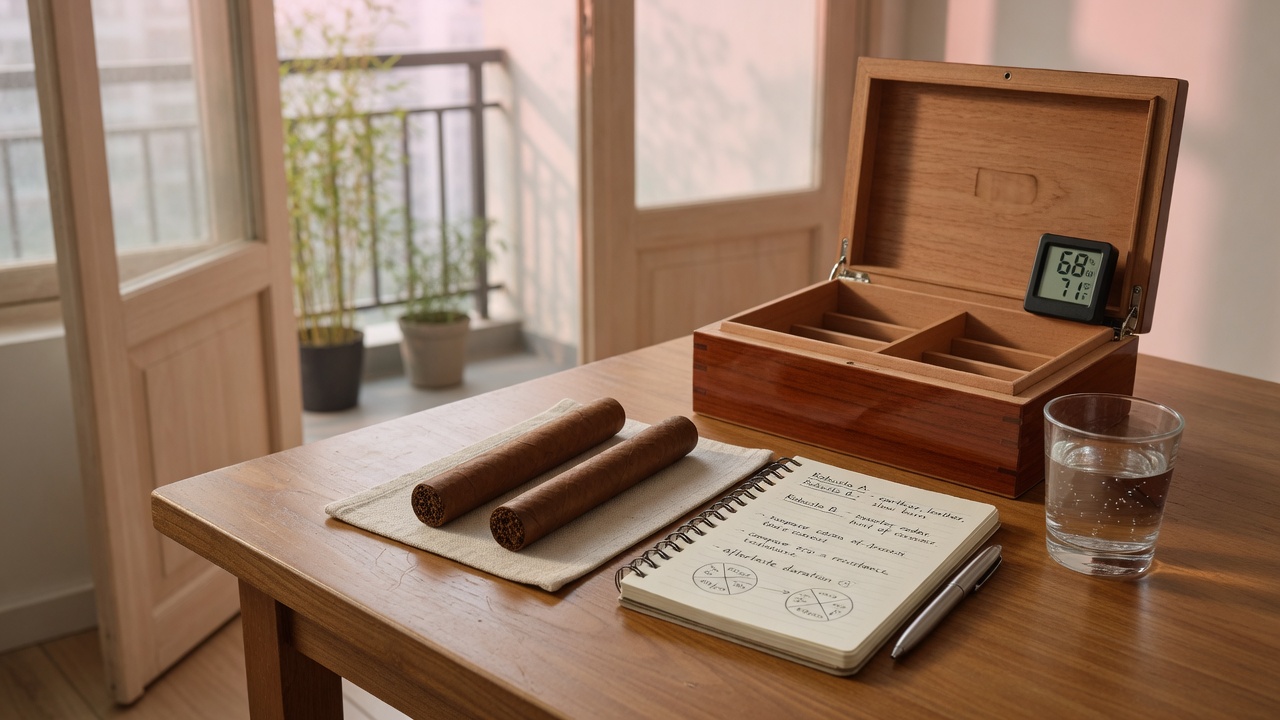
April 16, 2022, 3:40 PM, a Shanghai Xuhui apartment with a balcony. The balcony door was half-open; 21°C outside, indoor AC set to 24°C. My small hygrometer was taped to the side of a wooden cigar humidor: the box showed 71% RH, while the room-side read 48% RH — a classic "humid inside the box, dry in the room" scenario. On the table lay two Robusto cigars, both with a ring gauge of 50: one was my entry-level sample labeled "Dominican, mild-to-light," and the other was a sample a friend brought from Guangzhou, with Nicaraguan filler on the packaging. I planned a 90-minute comparison.
The result was embarrassing.
From the cold draw to the finish, I only wrote four lines in my phone memo:
- "Smoky taste"
- "A bit woody"
- "Middle section seems sweet"
- "Throat a bit dry"
The second cigar was worse. At minute 28, staring at the screen, I found myself typing the same four words again. My friend asked, "What's the difference between these two?" I froze for nearly 20 seconds, finally squeezing out: "I guess... the second one is a bit more intense?"
That afternoon, for the first time, I seriously wondered: It's not that all cigars taste the same — I had "operated" the differences out of existence. Over the next two years, I broke down "all taste the same" into a reproducible checklist of failures — insufficient experience, incorrect draw technique, humidity and environmental interference, wrong strength selection, and lacking a recording protocol. This article is that checklist, plus the fixes I only believed after falling into the pits myself.
First, set the boundaries, so everything that follows holds:
- Being able to distinguish flavors does not reduce health risks. Clear cedar notes and a clean finish do not equate to greater safety. Burning tobacco products still carry nicotine dependence and multiple harmful exposures (including CO, PAHs, etc.).
- This article discusses sensory conditions and misconceptions, not how to smoke more, deeper, or longer. If you are quitting or do not smoke, you can practice vocabulary with reference items and read records without needing to light a cigar.
- "All the same" is often a problem of conditions and protocols, not universal truth. In public resources and enthusiast practice, humidity, draw rhythm, ring gauge matching, cold draw, and segmented recording all significantly rewrite the performance of the same cigar.
- Personal notes are not laboratory data. It's normal for two people to describe the same cigar differently; what we want is our own before-and-after consistency, not to pretend to be objective instruments.
Every single one of these, I have personally fallen into at least once. This is not making fun of beginners — it's my own medical history.
| # | Surface Complaint | What's Actually Happening | What the Result Looks Like |
|---|---|---|---|
| 1 | Insufficient experience | No reference points in the brain for "cedar/roasted almond/pepper," etc., everything collapses into "smoky taste" | Notes only have emotional words |
| 2 | Draw too fast | Intervals shorter than 20–25 seconds, cigar overheats, delicate oily aromas are masked by scorch | Middle and final sections are all "scorched, bitter, harsh" |
| 3 | Humidity off | Long-term box humidity >72% or <60%, or large fluctuation within a week | Too wet: dull, muted, hard to draw; too dry: sharp, hot, papery |
| 4 | Environmental cross-contamination | After meals, perfume, coffee residue, cooking oil fumes, AC blowing directly | Interference written into the "cigar itself" |
| 5 | Strength overwhelms | Starting with full strength, large ring gauge, nicotine impact drowns out details | Only remember "intense" |
| 6 | Only record the beginning | First 5–8 minutes dominated by ignition gas, ignoring the middle section development | Every cigar seems "a bit harsh" |
| 7 | Confusing kick with flavor | Treating throat impact and lightheadedness as "flavor complexity" | The stronger the "better taste," the lighter the "no taste" |
Personal view: Among the seven, humidity + rhythm + comparison protocol solved at least 70% of my own "all taste the same" problem. The remaining 30% is down to "try more regions, take notes, train vocabulary." Many people get the order backwards: first curse themselves for having no talent, then curse the cigar for having no soul, and only finally think to check whether the hygrometer in their humidor has been drifting for two months.
In the winter of 2021 in Beijing, I smoked only medium-strength cigars of the same price range and the same style for three consecutive months, with ring gauges fixed at 50–52. A friend said, "Your taste is so consistent," which I took as a compliment. In reality, it was too small a sample variance: the same filler logic, similar sweetness and woody structure, inherently narrow differences. Without a reference, the brain gets lazy and rounds the narrow differences down to zero.
A common approach in enthusiast training is to first recognize broad categories by flavor family — woody, nutty/creamy, baking sweet, spice, earthy/leathery, green/grassy/char — and then break down further. Public tasting discussions also repeatedly remind us: notes like "cedar, cocoa, black pepper" are mostly impression families, not chemical reagent labels; it's normal for two people to write different things, but if you always only write "smoky taste," the training hasn't even begun.
2. How I ChangedJuly 9, 2023, a corner seat in a Guangzhou Tianhe cigar lounge. About 25°C inside the lounge, I ordered two samples deliberately stretching the difference (only seriously comparing these two that day, not being greedy):
- A: lighter, cold draw had obvious "pencil wood/cedar" feel
- B: medium-to-strong, cold draw had earthy and pepper tingling
Only three rules:
- Forbidden to write "smoky/tobacco/fragrant/okay" as the sole conclusion;
- Each segment must record at least: one attribute + 0–5 intensity + location (nose/tongue/throat);
- Record once each for: cold draw, first 1/3, middle 1/3, final 1/3.
90 minutes later, A's spine was "woody 3 → nutty 2 → tail section slight dryness," B's was "pepper 3 → earthy 3 → tail section bitter note rising." It wasn't a sudden epiphany — the forced fields tore through the fog.
Personal rule: Before completing 10 consecutive serious records, don't rush to expand your vocabulary. First get "family + intensity + time position" running smoothly. Vocabulary inflation is worse than having no words — in 2021 I wrote "a dusk-highway kind of woodiness," and three months later even I couldn't understand it.
3. Misconception 2: Wrong Draw Technique — Turning Cigars Into "Hot Bitter Scorch" 1. Too Fast: Temperature Kills Flavor FirstA common rhythm mentioned in industry and lounge practice is: roughly one puff every 30–60 seconds, allowing the cigar to maintain a slow smolder rather than sustained high heat. When too fast, you'll first taste the scorched bitterness of uncontrolled combustion before tasting the blend's sweetness and wood.
November 3, 2022, 9 PM, at my home in Hangzhou Xihu District. I deliberately did a comparison: two adjacent cigars of the same brand (taken from the same box, which at the time read about 66% RH).
- First cigar: average about 18–22 seconds per puff, finished about 2/3 in 45 minutes. Notes keywords: scorched, bitter, tongue tingle.
- Second cigar: strictly ≥40 seconds interval, timed on my phone. The middle section revealed "roasted nut 2, cocoa note 1" that I had never written before.
Same blend, not split personality — different temperature curves.
2. Deep Inhalation Into the Lungs: Shutting Down the Tasting ChannelThe mainstream tasting path for cigars is: hold the smoke in the mouth briefly (I usually do 2–4 seconds), then exhale part through the nose, using retronasal olfaction to capture aromas. If you inhale deeply into the lungs like a cigarette, your attention will be consumed by coughing, dizziness, and nicotine impact, and the aroma dimension collapses directly.
Personal view: "Knowing how to smoke" at the beginner stage is 70% rhythm and path, 30% talent. If the rhythm is wrong, even the most expensive cigar is just heat and harshness.
3. Cut and Lighting: Small Steps Amplify Noise- Cut too deep: loose structure, empty draw, unstable combustion, off-notes increase.
- Cut too shallow: high draw resistance, causing subconscious hard puffing, overheating again.
- Using a torch lighter directly on the core for too long: the first few minutes are full of fuel gas and scorched sensation, and many people characterize the entire cigar from this.
My fixed routine (almost unchanged since 2024):
- Cut: aim for a smooth cold draw, prefer shallow over deep, can do a second fine adjustment;
- Cold draw 2–3 puffs, first record cold aroma (woody? sweet? green? scorched?);
- Lighting: charcoal flame or steady flame, circling the foot, wait for a uniform red ember before formally drawing;
- First 3–5 puffs are just "priming the furnace," no conclusion sentence.
February 18, 2024 in Beijing, I cut one too deep, the cold draw was already airy. After forcing 20 minutes of smoking, all notes were "empty, bland, papery." Switched to another of the same type with a normal cut, immediately back to "woody + slight creamy note." That day I cursed my scissors, not the growing region.
A recurring phenomenon in enthusiast communities and humidor discussions:
- Humidity too high: draw resistance increases, front section feels dull and bland, details seem masked by a wet cloth, many will say "all taste the same, no kick."
- Humidity too low: draws more easily, but more prone to becoming sharp, hot, papery, or having sharp bitterness, oily complexity decreases.
- Fluctuation is worse than a "slightly off but stable" value: if the box oscillates between 60%–75%, the same cigar can seem completely different on different days.
Common public empirical discussions suggest a numeric range worth remembering: approximately 65%–70% RH as the central discussion band for consumer-end storage (specific targets can be fine-tuned depending on climate, individual habits, and wrapper type; some prefer 62%–65% for cleaner burn). The key is not being superstitious about a specific integer, but rather stability + measurability.
January 2023, my desktop humidor showed 74%–76% for two consecutive weeks (seal aged). I smoked four different brands, notes highly homogenized: "dull, sweetness clumped together, hard to draw." Replaced the seal, used a two-way humidity pack to bring the box back to 66%–67% and stabilize for 10 days. Of the same four, two pulled apart again — one had cleaner woody notes, the other clearer pepper.
Personal view: If humidity is wrong, don't rush to sentence the cigar to death, and don't rush to suspect your nose is broken. Fix the box first, then talk about flavor philosophy.
2. Minimum Viable Configuration| Item | What I Actually Do | Notes |
|---|---|---|
| Measurement | Calibrated digital hygrometer | Don't rely on feel "damp or not" |
| Target range | Mostly 65%–68% RH | You can fine-tune based on burn and palate |
| Stability | Open lid less, avoid direct sunlight and near radiators | Fluctuation is worse than absolute value |
| Recovery | Give several days to two weeks after too dry/wet before evaluating | Conclusions unstable right after adjustment |
| Record | Write "box RH + room temperature" in notes | Explains why the same cigar differs on different days three months later |
May 12, 2024 in Shenzhen, hotel room 28°C, AC dehumidifying. I put two cigars into a temporary ziplock bag + humidity pack, opened them after about 12 hours. One was still slightly dry, sharp front section; the other was in normal condition. Same batch, same trip — the difference was whether temporary storage was taken seriously. In travel scenarios, "all taste the same" often equals "all dried out."
5. Misconception 4: Environment and Body State — You Are Tasting the Interference Source 1. Common Contaminants| Disturbance | Specific Examples I've Experienced | How Notes Were Contaminated |
|---|---|---|
| Within 1 hour after a meal | 2022 Chengdu hot pot after | "All numbing, oily, sweet," cigar itself disappeared |
| Perfume/aftershave | 2023 Shanghai exhibition | First 15 minutes felt like smoking floral air freshener |
| Espresso | 2021 Beijing cafe outdoor seating | Bitterness stacked, mistaken for wrapper scorch |
| Stuffy nose/allergies | 2023 spring in Beijing | Only irritation and dryness left, aroma dimension shut down |
| AC blowing directly | 2024 Guangzhou office balcony | One-sided burn, scorch increased |
| Consecutive tasting | 2022 Hangzhou, 5 cigars in one session | Resolution dropped off a cliff from the 4th cigar onward |
- Serious tasting: at least 90 minutes after a meal, only drink plain water;
- No perfume on tasting day, wash hands to remove oil;
- On stuffy nose days, directly cancel "conclusion-level" records, at most write "abnormal condition, inconclusive";
- Seriously evaluate 1 cigar, at most 2 in one session; the 3rd is just for fun, no notes;
- If there's wind, change position, don't stubbornly stay for the photo.
Personal view: Many people don't lack the ability to taste — they are in the wrong room, in the wrong body state, making the right effort on a cigar at the wrong humidity. The effort direction was correct, but the entire coordinate system was wrong.
6. Misconception 5: Strength and Ring Gauge — Using the Wrong Tool and Blaming the Material 1. Too Strong "Flattens" DetailsBeginners are often driven by "wanting to feel something," going directly to full strength and large ring gauge. The result is that the palate is overwhelmed by the impact, and delicate notes of cream, citrus peel, and light wood all give way to "intensity." Common beginner advice repeatedly emphasizes: start from light to medium strength, giving aromas room to emerge, then gradually try stronger blends.
September 2, 2023, an outdoor table at a Xiamen bar. A friend handed me an obviously strong sample. For the first 20 minutes I only felt: lightheaded, tongue root numb, pepper tingle. Zero woody, zero sweet notes recorded. Three days later, using a medium-strength cigar from the same growing region as a reference, I could immediately write down woody and nutty notes. Not an epiphany in three days — the strength gave the microphone back to me.
2. Ring Gauge and Time MismatchLarge ring gauge, long size require time. If you only have 25 minutes but light up a specification that needs 70–90 minutes, you will typically:
- Subconsciously speed up drawing → overheating;
- Snub out before the middle section unfolds → only remember the front section's ignition gas;
- Psychological anxiety → draw even more intensely.
Personal rule: If available time is less than 45 minutes, I default to only choosing short sizes or small ring gauge; if I want to seriously record with a 50+ ring gauge Robusto, I reserve 70–100 minutes (including notes).
7. Misconception 6: Only Recording the Beginning, and Confusing "Kick" With "Flavor" 1. Three Sections: Front, Middle, Final — The Middle Is Most HonestA well-constructed cigar typically has a front section that transitions from ignition and wrapper cold aroma, a middle section where the blend's intent is clearest, and a final section that may concentrate, turn bitter, or turn scorchy — depending on burn and humidity.
My fixed timeline since 2024:
| Stage | Approximate Position | Question I Force Myself to Ask |
|---|---|---|
| Cold draw | Before lighting | Main attribute: woody/sweet/green/earthy/scorched? Intensity out of 5? |
| Front section | First 1/3 | Has the ignition gas dissipated? What is the first stable main note? |
| Middle section | Middle 1/3 | Write the main conclusion here; is there a secondary attribute? |
| Final section | Last 1/3 | Has it become richer, or is it scorched/bitter/dry out of control? |
| Aftertaste | 2 / 5 minutes after putting it down | What remains? Clean or lingering? |
In that 2022 Shanghai flip, I only wrote notes in the first 10 minutes. The middle section had already diverged, but I was scrolling on my phone — essentially actively throwing away the section with the most difference.
2. Kick ≠ Flavor"Harsh/intense/heady" describes physiological impact and body sensations — you can record them, but they cannot substitute for attribute words. Otherwise, you'll fall into a cycle: the stronger the better, the lighter the more boring — eventually all delicate constructions equal zero in your linguistic system.
Personal view: Strength is the vertical axis; flavor families are the horizontal axis. With only the vertical axis, your map is always a single line.
8. Improvement Summary Table: From "All Taste the Same" to "Able to Articulate Differences"Compiling the previous pitfalls into an actionable table.
| Misconception | Immediately Actionable Fix | Suggested Number/Condition |
|---|---|---|
| No comparison | Deliberately stretch two styles apart, forced-field recording | Same day seriously ≤2 cigars |
| Drawing too fast | Use phone timer, slow down | About 30–60 seconds/puff |
| Wrong path | Hold in mouth then exhale through nose | Hold about 2–4 seconds |
| Humidity drifting | Calibrate hygrometer + stable storage | Common discussion band about 65%–70% RH |
| Dirty environment | No conclusions after meals, perfume, stuffy nose days | After meals ≥90 minutes |
| Too strong | First train discrimination with medium-light strength | Too harsh, switch to another cigar and practice |
| Only record beginning | Four sections: front, middle, final + aftertaste | Middle section must have a main attribute sentence |
| Vocabulary too vague | Ban "smoky taste" as sole conclusion | Attribute + 0–5 points + location |
- Before opening the box: check the hygrometer, write RH, room temperature, own body state.
- Appearance and cold draw: 2–3 puffs, only record cold aroma.
- Lighting: evenly toast the foot, first 3–5 puffs no conclusions.
- Rhythm: ≥30 seconds per puff; if the burn line runs off, correct slowly, don't suck hard to rescue.
- Three-section recording: 1 main attribute + intensity + sensory location per section.
- Aftertaste: 2 minutes and 5 minutes after putting it down, check what remains.
- One-sentence summary: max 25 words, must include "middle section main note."
Example summary (my June 8, 2024, Shanghai notes): "Cedar 3 + nutty 2 in middle, final section dry 2, box 66% RH, rhythm normal."
9. Three of My Own Comparison Experiments (With Time and Location) Experiment A: Rhythm (Hangzhou, 2022-11-03)- Two cigars from the same box, box about 66% RH.
- Fast draw vs ≥40 seconds interval.
- Conclusion: Fast draw erased middle section nutty/cocoa into scorched bitter; slow draw wrote them back.
- Four cigars in the over-wet period "uniformly turned dull."
- After 10 days of stabilization, two pulled apart again.
- Conclusion: Fix humidity first, then talk about growing region narratives.
- Two cigars deliberately different in style.
- Forbidden to use "smoky taste" as sole conclusion.
- Conclusion: Differences "suddenly appeared" under forced fields — essentially rescued by the recording protocol, not that the cigar magically improved overnight.
- "All taste the same" should first be treated as an operational troubleshooting, not a talent verdict.
- Humidity and rhythm are the foundation; vocabulary is decoration. Lay the foundation first.
- The middle section is most honest. People who only evaluate the first five minutes tend to turn the whole world into the same cigar.
- Strength is the vertical axis; flavor is the horizontal axis. Don't substitute the vertical axis for the horizontal axis.
- One cigar seriously done in a day is better than five cigars carelessly done. Olfactory fatigue is real.
- Being able to describe flavors does not make smoking legitimate or safe. The boundary must always be stated.
If you are already using a recording sheet (metadata, cold aroma, front/middle/final, retronasal, 0–5 scale, uncertainty downweighting), this article solves a more upstream problem: why the sheet fills up with the same words every time.
- The sheet is the language protocol;
- This article is the conditions and misconceptions protocol.
Stacked together, differences can hold. If all conditions are wrong, the sheet will merely neatly record "a failed combustion."
12. A Reproducible One-Page Self-ChecklistWhenever you feel "how is it all the same again," check off in order:
- [ ] Is the box RH within your set stable range? (write down the reading)
- [ ] Has humidity fluctuated significantly in the last 7 days?
- [ ] Stuffy nose, just ate heavy food, wearing perfume today?
- [ ] Is the cut too deep/too shallow? Is the cold draw smooth?
- [ ] Is the average puff interval ≥30 seconds?
- [ ] Am I inhaling the smoke into my lungs like a cigarette?
- [ ] Is the strength too strong causing details to disappear?
- [ ] Did I only write notes in the first 10 minutes?
- [ ] Do my notes have a banned word dominating the conclusion (smoky taste/fragrant/okay)?
- [ ] Am I still writing "formal conclusions" for the 3rd+ cigar in a row?
If two or more are unchecked, don't low-score the cigar first, and don't sentence yourself to "no tasting cells" first.
Conclusion: Turn Complaints Into Repairable Error CodesBack to that afternoon on April 16, 2022, on the Shanghai balcony. Box 71% RH, draw slightly fast, note fields missing, the two styles weren't even deliberately stretched apart — under this configuration, arriving at "all taste the same" was a reasonable output, not universal truth.
Later, whenever I hear myself or someone else utter those five words, I subconsciously translate them into a string of error codes:
RH? Rhythm? Environment? Strength? Fields?
Most of the time, fixing two or three of them will make differences re-emerge from the fog. After they emerge, you still may not like a certain cigar — that's fine. Being able to say "I don't like its middle section pepper and final section dryness" is far more useful than only being able to say "they all taste the same."
Finally, repeating the boundary: this set improves observation and recording ability, not safety. If your goal is to reduce or stop using tobacco products, tasting training can be used to identify rituals and triggers, not to extend usage. A more sensitive nose does not mean lower risk.